
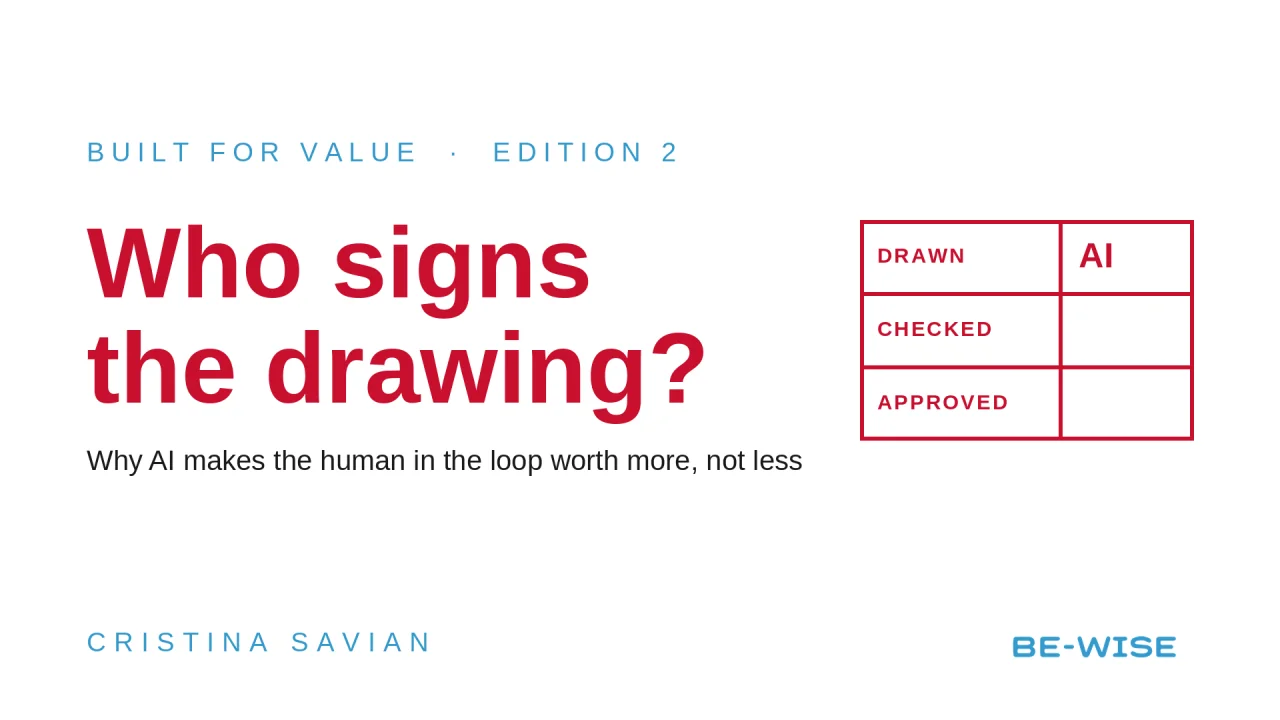
Why AI makes the human in the loop worth more, not less
Last week I made a short film in which I am replaced by AI.
Someone asks a chatbot to act as Cristina Savian and write their AI strategy. It answers in seconds: three phases, a confident return on investment and a 200-page PDF. Twelve months later, the plan has failed, the chatbot apologizes, and it starts the same plan again.
It is played for laughs. The pattern behind it is not, and I keep seeing it.
The box in the corner
Every drawing in our industry carries a small box in the corner, the title block. Somewhere in it are three short words: drawn, checked, approved.
Each word has a name next to it. The first is the person who produced the work. The second is the person who looked at it with fresh eyes and asked whether it was right, and the third is the person who put their professional judgement behind it.
That box is the oldest version of what we now call a human in the loop. We did not invent it for AI. We invented it because buildings and bridges hold people, and someone has to answer for them.
AI has taken the first box
AI is now very good at "drawn". It writes the strategy, the report, the specification and the tender response, and increasingly it proposes the design option too. It does it in seconds, at almost no cost, and it never gets tired.
I think that is wonderful. I have no nostalgia for the hours our profession has spent on work a machine can now do.
But look at what happens to the other two boxes. When drafting is almost free, the amount of drafted work explodes, and checking does not get cheaper at the same speed.
So who is checking?
Why now more than ever
There is a comfortable argument that AI makes the human less necessary. If the first draft is this good, why pay someone to look at it? I understand the appeal, and I disagree with it completely.
AI does not know what it does not know. It reads whatever data we give it with complete confidence, and it writes just as confidently whether the data is right or wrong.
A plan that puts sensors on every asset before anyone has asked which decision they will change does not look wrong. It looks thorough.
And AI cannot sign. It cannot stand in front of a board, a regulator or a family and explain what it recommended and why. That is still our job.
I crossed the Morandi Bridge in Genoa as a child, and I watched it collapse. I am not suggesting that AI had anything to do with it. I am saying that in our profession the check has never been paperwork: it is a duty of care.
What a human in the loop is not
It is not a name typed into the "checked" box of a document nobody has read. A 200-page PDF produced in seconds can be approved in seconds too.
That is the real risk. Not that AI replaces the expert, but that we keep the expert's name and lose the expert's judgement.
It is also not someone who checks the grammar. The question the checker asks is not "is this well written?" It is "does this fit the asset, the budget and the people who will run it?"
When did someone in your organisation last send an AI-written document back?
If nobody can remember, the loop may already be open.
Where the human belongs
In the first edition I set out the Decision Test: five questions a board answers before it funds AI or a digital twin. The second question matters most here: who makes the decision today?
That person is the human in the loop. AI should help them decide faster and with better information. It should not decide for them, and it should never make them invisible.
This is also where digital twins earn their place alongside AI. A checker is only as good as what they check against, and if the buildingis picture is from handover day, even the best expert is checking against an asset that has since changed. The smartest move in AI is a digital twin you can trust, because it gives the human in the loop something true to stand on.
The box we forget
A quieter problem worries me more.
Most of us learned to check by drawing first. We made mistakes, someone senior caught them, and slowly we became the ones who caught them for others.
If AI does all the drawing now, how will the next generation learn to check?
A board that cuts junior roles because first drafts are now free may find, in ten years, that nobody is left qualified to sign.
What I would ask of your board
Before the next AI tool goes live in your organization, fill in the title block.
Name who checks and who approves every piece of AI-drafted work that reaches a client, a regulator or a building. Give those people the time and the authority to say no. Then protect the path to becoming a checker, because that is your expertise for the next twenty years.
None of this slows AI down. It is what lets us trust it enough to use it properly.
Why I am optimistic
I am more optimistic about this industry than I have been for a long time. AI will take the drudgery out of the first box, and it will make good experts faster and better informed than any generation before them.
But the corner of the drawing still matters. It is where our profession has always written down who is responsible, and we must keep real names in it.
Tell me, in a comment or a reply, how your organisation keeps a human in the loop, or where it has quietly stopped.
If you want an expert in the loop on your next AI decision, book a conversation with me: https://cal.com/cristina-savian/letstalk